8 Dishes to Eat in Naples and Where to Find Them
 By Lauren Hayes
In Naples you often eat standing up, fast and for a few euros, usually with a napkin folded around something fresh out of the fryer. Over five days in late October, I ate on the sidewalk about as often as at a table, maybe more.
But it's also easy to eat badly. The same street can have a good friggitoria, a little place that sells fried food over the counter, right next to a spot with signs in English that lives off passing tourists.
Here are eight dishes in the order I'd eat them over one day, from a sfogliatella before 9 a.m. to pizza at night.
1. Sfogliatella at the counter, before 9 a.m.
A sfogliatella, a crisp pastry with a ricotta filling, is a sensible way to start while the city is still pulling up its shutters. It comes as riccia, with thin, flaky layers, or as frolla, with a smooth shell of shortbread-like dough.
I had my first one just after 8:15 a.m. near Via Toledo, in the passage into the Galleria Umberto I. Around 2 to 3 euros is a normal price in the center. Say "una sfogliatella riccia, per favore" if you want the flaky one.
Sfogliatella Mary in the Galleria Umberto I is well known and can have a line. The one I got there actually wasn't the best of the trip, because it had cooled off and lost some of its crunch.
2. Caffè standing at the bar, around 9:30 a.m.
A caffè is a small espresso, and you don't linger over it here. You walk in, often pay at the register first, take the receipt to the counter and just say "un caffè."
I paid about 1.30 to 1.80 euros at the counter, depending on the location. At the bars around Via Toledo and Piazza Dante, the whole thing often took two minutes.
If you sit down at a table, a lot of places charge more. Standing worked better for me anyway when the rain rolled in and everyone crowded under the awnings.
3. Frittatina di pasta on Via dei Tribunali, before lunch
A frittatina di pasta is a deep-fried puck of pasta, usually bucatini with béchamel, peas, ham and cheese. It should be firm on the outside and almost creamy in the middle.
I bought one at a friggitoria on Via dei Tribunali around 11:15 a.m. and paid about 2 to 3 euros. Order "una frittatina classica" and eat it straight out of the paper.
It's a small dish, but it's heavy enough to push lunch back an hour. I learned that after ordering two on the first day.
4. Pizza fritta in the Centro Storico, around one
A pizza fritta is a stuffed, deep-fried pocket of dough, and it's bigger than it looks folded up in its paper. The classic filling is ricotta, provola cheese, cicoli (pork cracklings), black pepper and sometimes tomato.
Around Via dei Tribunali and the alleys south of it, plenty of friggitorie sell it over the counter. I paid about 5 euros for a whole one.
Ask for "una pizza fritta completa" if you want the standard filling. Give it three minutes before the first bite, because the ricotta stays hot for a long time.
5. Pasta e patate con provola in the Quartieri Spagnoli, at 2:30 p.m.
Pasta e patate con provola, a dense, hearty mix of pasta, potatoes and melted cheese, is the first dish of the day I want to eat sitting down. The pasta and potatoes cook together until the starch binds everything, and then the provola gets stirred in to melt.
I had it in the Quartieri Spagnoli, the Spanish Quarter, a few blocks up from Via Toledo. Around 7 to 10 euros is a fair range for a plate at a simple trattoria.
Ask for "pasta e patate con provola," and if you're going late, check how long the kitchen serves lunch. Around three, several of the small places were already starting to clean up.
6. Babà on Via Toledo, around 4:30 p.m.
A babà is a yeast cake, soft and glossy and heavy with sugar syrup. The Neapolitan version is traditionally soaked in rum and comes in small single-serving sizes.
I got one along Via Toledo for about 2 to 3 euros and ate it standing up, with an extra sheet of paper underneath. Say "un babà, per favore."
This is one case where smaller is better. A bigger, heavily soaked babà was mostly just sweet and soggy, while the small one had a better balance of rum and cake.
7. Cuoppo di mare at Pignasecca, before 7 p.m.
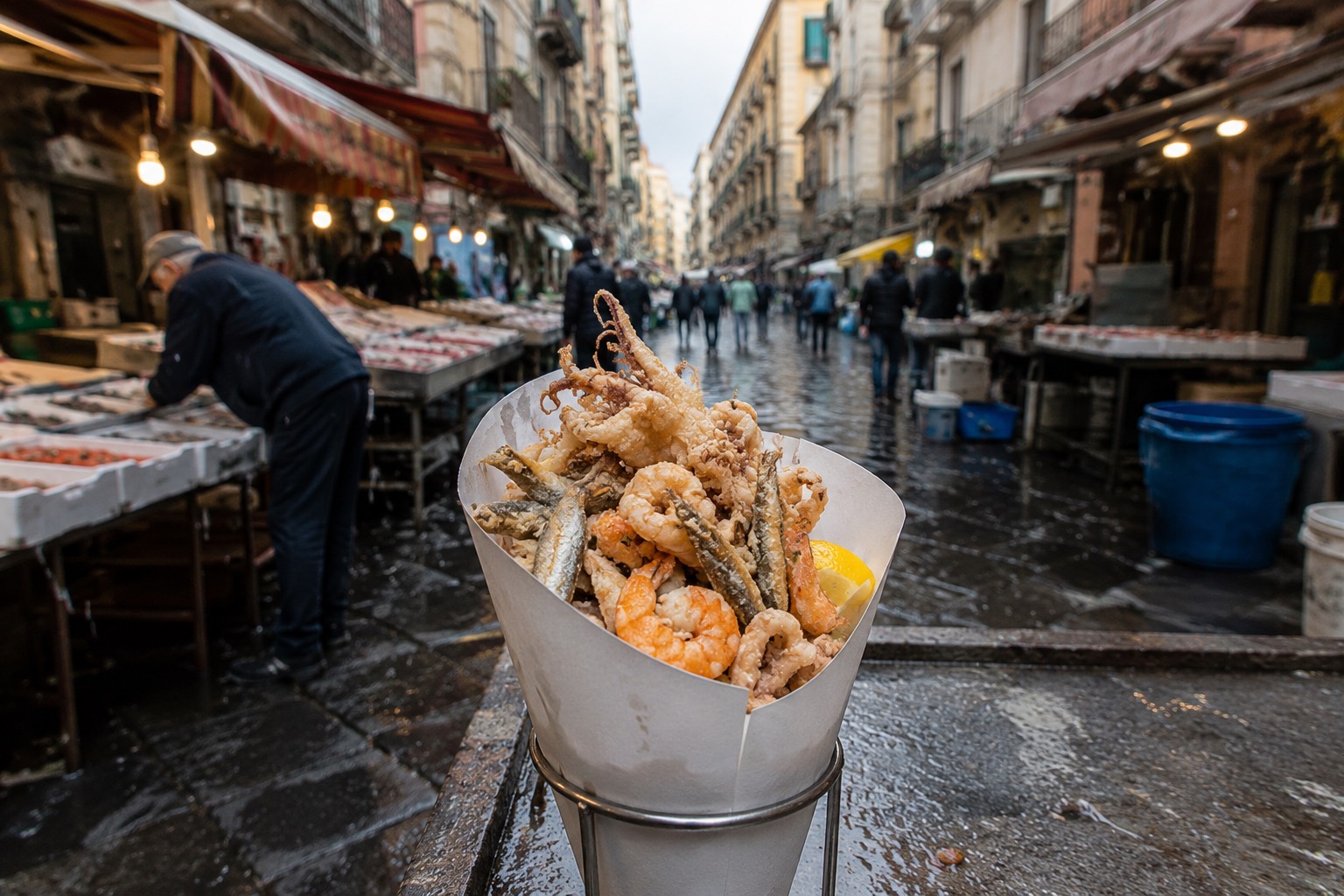
A cuoppo di mare, a paper cone of fried fish and seafood, is the thing to get while the Pignasecca market is still going. What's inside varies, but small fish, anchovies, squid and shrimp are common.
I came in from the Montesanto end just after six and paid about 5 to 8 euros for a mixed cone. Order "un cuoppo di mare" and point to the size you want if there's more than one.
Things move fast on Via Pignasecca. I ate leaning against a closed shop's metal shutter while a fishmonger hosed down the sidewalk next to me.
8. Pizza margherita in the evening, after 8:30 p.m.
Pizza margherita, a thin pizza with tomato, mozzarella and basil, is the one I save for last. In Naples it usually comes out fast, with a soft center and a crust you can fold.
At pizzerias in the Centro Storico, a basic margherita often costs around 6 to 9 euros, roughly $7 to $10. Say "una margherita," and add "da asporto" if you want it to go.
I also tried L'Antica Pizzeria da Michele on Via Cesare Sersale, where you take a number and wait outside. The wait was a little over 20 minutes when I showed up that evening. The pizza was good and cheap, but its reputation had me expecting more.
Good to know
- Many places take cards, but carry a few euros in cash for smaller food vendors
- At a bar, you often pay at the register first and show your receipt at the counter
- Eat anything fried right away, because even a five-minute wait makes a difference
- Pignasecca is best before the market stalls start closing for the evening
- Say "da asporto" for takeout and "al banco" if you want to stand at the counter
- Booking a table and lingering over a multicourse dinner takes more planning here
After five days, the first thing on my mind when I left Naples wasn't the pizza. It was the sound of the fryers at Pignasecca around six. I had grease on my camera strap, rain in my hair and half a napkin still in my pocket, and that felt like a fair picture of how I'd eaten my way through the city.